Tausret: Forgotten Queen and Pharaoh of Egypt by Richard H. Wilkinson
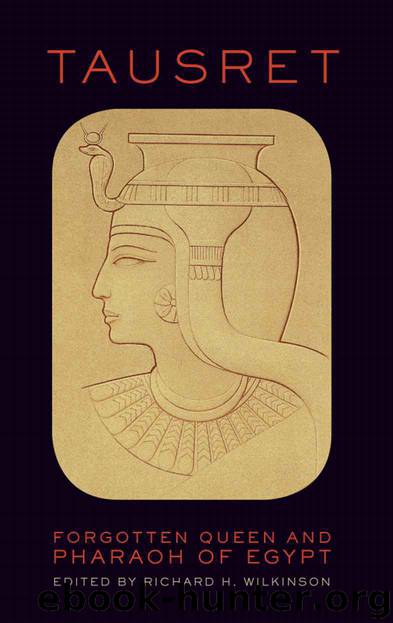
Author:Richard H. Wilkinson
Language: eng
Format: epub
Publisher: Oxford University Press
Published: 2012-03-13T16:00:00+00:00
Most of the titles and epithets in these inscriptions are in the masculine form—for example, “Son of Re,” but this should not be taken as an attempt on Tausret’s part to be understood as a man. Her two cartouche names, those most commonly written on monuments, clearly state her feminine gender. Her throne name, Sitre-Meryamun, begins with the feminine “Daughter of Re” (Sitre). Her personal name, Tausret-Setepenmut, includes the feminine name she was given at birth, Tausret, and the phrase “chosen of Mut” (Setepenmut), which associates her with a powerful goddess who is often included in the names of queens.25 Most of her male predecessors, beginning with Ramesses II, used the phrase “chosen of Re” (Setepenre), thus associating themselves with a god.
In the inscriptions on the Medinet Nasr statue, Tausret is described several times as “beloved of Hathor, Lady of the Red Mountain.” The red mountain in question is near the site where the statue was found and has a similar name today, el-Gebel el-Ahmar (“the red mountain” in Arabic)—a place that is noted for its quarries. Quartzite from this area had been employed by generations of Egyptian pharaohs, including Ramesses II who commemorated his use of the quarries in a stela now in Cairo (CG 34504).26 It is certainly not surprising that Tausret’s statue was also made of quartzite from these quarries.27
The Seated Statue of Ramesses II in Turin
Another parallel to Tausret’s Medinet Nasr statue is a seated statue of Ramesses II in the Egyptian Museum in Turin. Although similar in type, this greater than life-size statue differs in several respects. The Turin statue, which still has its head, depicts Ramesses wearing the blue crown (kheperesh) instead of the nemes-headcloth. Ramesses is dressed in the typical long, pleated garments of a king, but he wears no apron decorated with uraeus-cobras. Like Tausret, Ramesses holds his right arm bent up across his chest, but, as on his Cairo statue, he holds only the crook in his right hand—not the crook and flail as does Tausret. Ramesses rests his left arm on his left leg and he holds a cloth in his left fist, whereas Tausret’s left hand lies open with the palm down.
Download
This site does not store any files on its server. We only index and link to content provided by other sites. Please contact the content providers to delete copyright contents if any and email us, we'll remove relevant links or contents immediately.
Fanny Burney by Claire Harman(26660)
Empire of the Sikhs by Patwant Singh(23135)
Out of India by Michael Foss(16986)
Leonardo da Vinci by Walter Isaacson(13411)
Small Great Things by Jodi Picoult(7227)
The Six Wives Of Henry VIII (WOMEN IN HISTORY) by Fraser Antonia(5558)
The Wind in My Hair by Masih Alinejad(5139)
A Higher Loyalty: Truth, Lies, and Leadership by James Comey(5017)
The Crown by Robert Lacey(4862)
The Lonely City by Olivia Laing(4841)
Millionaire: The Philanderer, Gambler, and Duelist Who Invented Modern Finance by Janet Gleeson(4538)
The Iron Duke by The Iron Duke(4405)
Papillon (English) by Henri Charrière(4322)
Sticky Fingers by Joe Hagan(4255)
Joan of Arc by Mary Gordon(4156)
Alive: The Story of the Andes Survivors by Piers Paul Read(4077)
Stalin by Stephen Kotkin(4006)
Aleister Crowley: The Biography by Tobias Churton(3671)
Ants Among Elephants by Sujatha Gidla(3494)
